Uninstall Perfectionism: Do Less, Achieve More
admin_tbl743x
The Better Life Lab
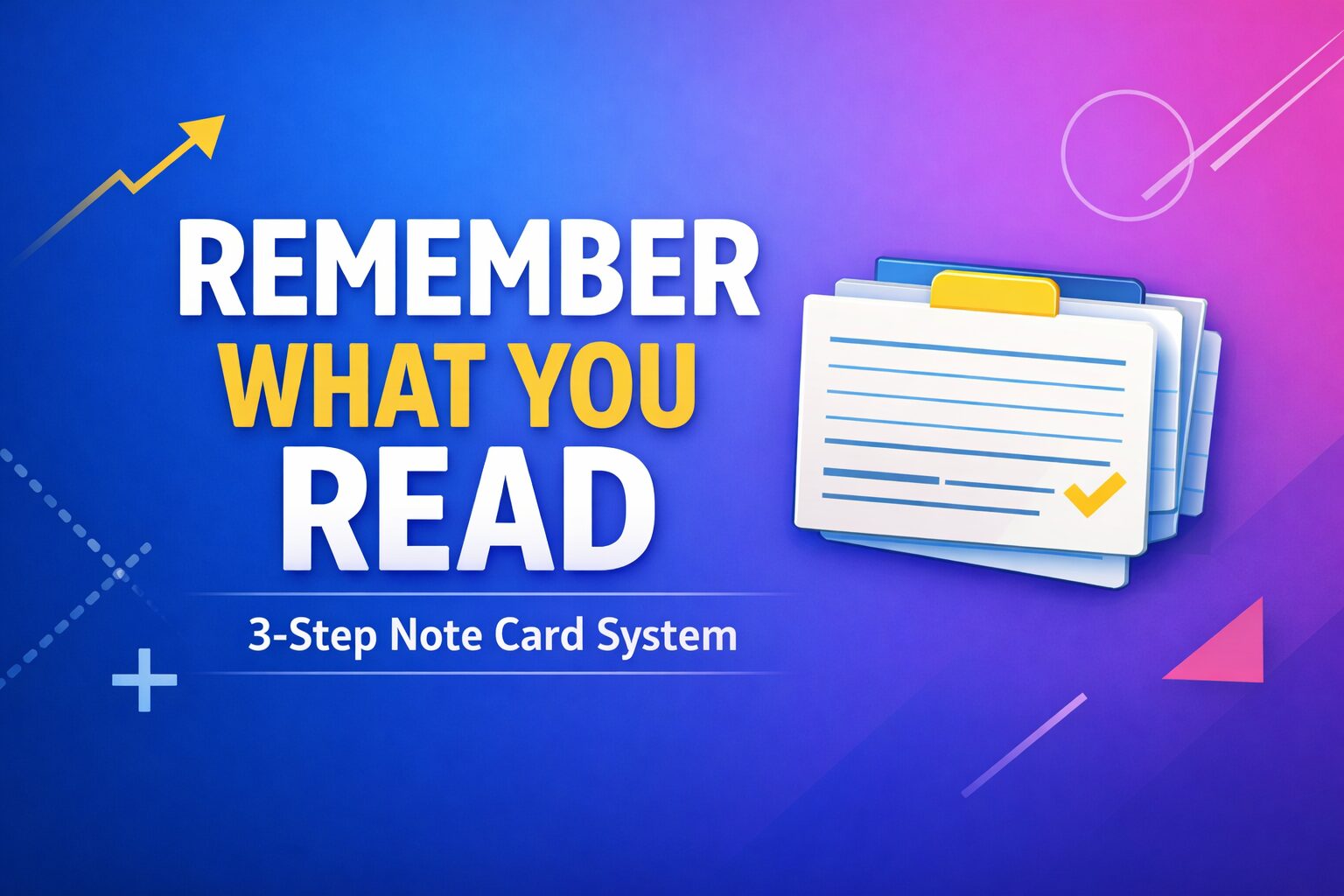
You finish a book, feel motivated, and then forget most of it by next week. That isn’t a character flaw. Your brain is designed to drop details that never get used. The fix is not “read harder.” It’s to give your brain three signals: “This matters,” “I used it,” and “It connects to something else.” In this article, you’ll learn a practical system inspired by filmmaker Matt D’Avella and writer Ryan Holiday. You will highlight only what you can apply, convert it into short note cards, and organize the cards so you can pull the right idea when you need it. You’ll also learn how to cut weak books early and turn one card into a 5-minute action plan.
Forgetting is normal. Your brain is always filtering. It keeps what you use often, what you used recently, and what feels personally important. A book can be interesting, but if you never touch the ideas again, your brain treats them as low-priority. That is why “read more books” often changes nothing. The better approach is to change how ideas enter your memory. You want three layers: select a small set of ideas, generate your own version of them, and connect them to a place you can return to later. This system does not require special talent. It simply matches how memory works: attention, repetition, and association. If you build those three on purpose, the book stops fading after one week.
Most people highlight what looks important to the author: bold lines, definitions, and famous quotes. That creates a colorful page, but it does not create recall. Use a stricter rule: highlight only what you can apply. Ask, “Where could I use this in the next 7 days?” If the answer is unclear, skip it. “Use” can mean many things: a sentence you can copy into a report, a question to ask in a 1-on-1, a checklist for a project, or a story you can use to persuade a team. This makes highlighting personal and practical. You are not collecting “good information.” You are collecting tools you will actually reach for.
Highlighting alone is passive. The next step is the “transfer.” Move each selected idea onto a small note card (index cards work well). Keep one card to one idea. Use a simple three-line format. Line 1: a short title, five words or less. Line 2–3: rewrite the idea in plain language, in your own words. Do not copy the book. Then add one extra line: “How I can use this:” followed by a specific use case. Example: “How I can use this: open my next proposal with a one-sentence promise.” This extra line forces meaning, and it also creates a trigger for action. Over time, your cards become a “use library,” not a memory test.
Trying to write “beautiful” notes is a trap. When you chase perfect wording, you slow down, and your best reactions disappear. You also tend to write vague lines that sound good but do nothing, like a company slogan. Notes are not for showing other people. Notes are for thinking. So write fast and concrete. Use simple verbs: “ask,” “cut,” “test,” “repeat,” “measure.” If the card feels messy, that is fine. You can clarify it later, but you cannot recover a good idea that you never wrote. Your goal is a card you can act on in real life, not a card that looks impressive.
Categorizing is the hidden engine. In school, many people took notes but did not sort them, so review felt random and painful. Sorting cards fixes that. When you categorize, you reread the card, decide where it fits, and compare it to other cards. That is a form of review and connection. Memory works better when ideas have “branches.” A name is hard to remember, but a name plus a story is easy. Do the same with book ideas by linking them to a category. Start with four buckets: Work, Relationships, Money, and Habits. Add new categories only after you have enough cards to justify them.
This method is slower. You pause to highlight, write cards, and sort them. Many people worry they will read fewer books. But slower reading can save time in two ways. First, you get better at quitting low-value books. When cards take effort, you become selective, and you stop forcing yourself to finish filler. That “cut your losses” mindset also helps outside reading. Second, one strong book starts to affect your choices for months, not hours. If you read ten books and forget nine, you stay the same. If you read one book, extract the tools, and test them, you change faster. Think of reading like a great meal: you don’t rush it, you digest it.
The biggest benefit is not sounding smart in conversation. The real benefit is turning reading into action. Pick one card and answer two questions: “Where will I use this?” and “When will I try it?” Then write a 5-minute plan: a specific situation, a tiny behavior, and a success signal. Example: “Tuesday team meeting: summarize the problem in one sentence before suggesting options. Success = fewer clarifying questions.” Keep the test small so you will do it. At the end of the week, add one sentence to the card: what happened and what you will tweak next time. This turns your box into an experiment log, not a graveyard of highlights.
Highlighting too much is the fastest way to make this fail. If half the page is marked, you have no signal, and you will skip the transfer step. Another mistake is copying the book word for word. Copying feels productive, but it keeps your brain passive. Rewrite in simple language, even if it sounds plain. A third mistake is over-engineering categories too early. Start with four broad buckets and let your system grow as your cards grow. Also, avoid turning review into a rigid weekly rule. Use your cards when you need them: before a project, before a conversation, or when you feel stuck. Finally, don’t confuse speed with learning. If your actions never change, reading becomes entertainment, not training.